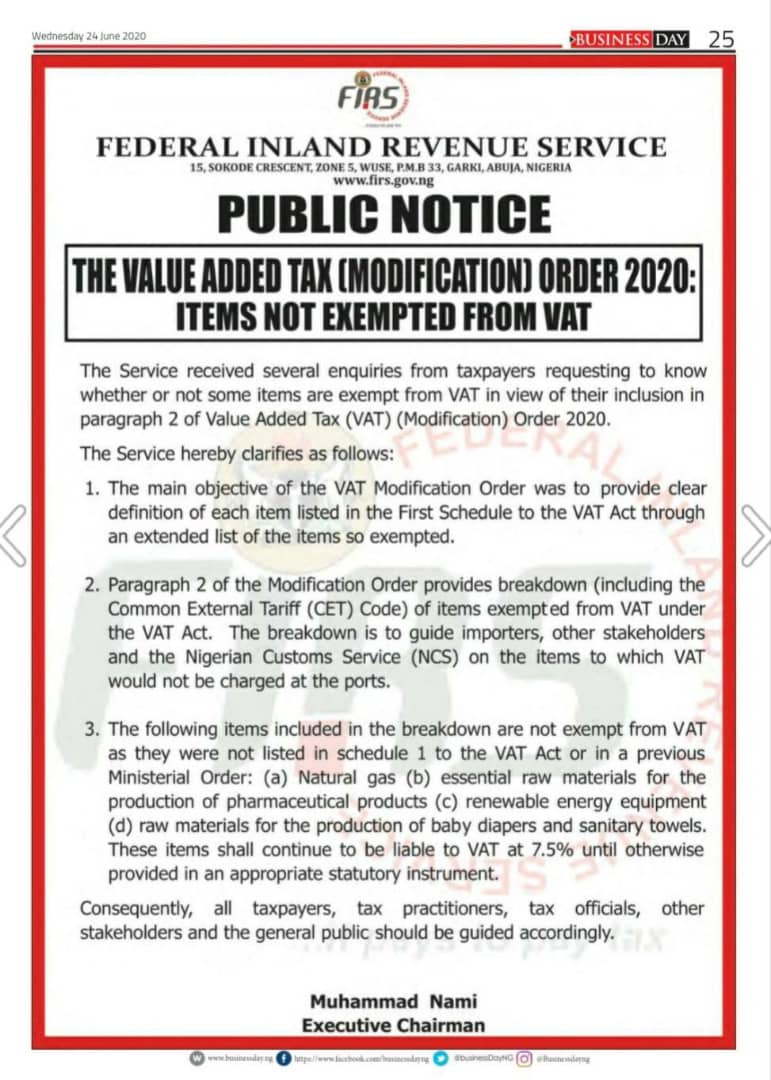
The Federal Inland Revenue Service (FIRS) issued a Public Notice on Wednesday, June 24, 2020. The Public Notice seeks to provide clarification to Paragraph 2 of the Value Added Tax (VAT Modification) Order 2020 (Modification Order) made by the Minister of Finance, Budget and National Planning (Minister) on February 3, 2020. We provide below, our synopsis and remarks on the Public Notice here. You can also find the Modification Order here.
Read MoreFirst Thoughts: The Glass Half Full
In recent times I have seen and heard reactions from a lot of people I know concerning how the year has turned out in a way most didn’t quite envisage. Some have even wished they had magic wands they could wave and make the entire year disappear or perhaps, restart. I would confess that I was one of these people for a while. Many of us had very high hopes for 2020 just like we always do at the beginning of every New Year. 2020 was quite significant however; perhaps because of the way it sounds when you pronounce it. At least, 2020 sounds a whole lot better than 2019 (or any other year before now) on the lips, don’t you think?
Read More

Introduction:
In the first part of this series; ‘How to Reduce Your Personal Income Tax (PIT) Liabilities: The Voluntary Pension Contribution (VPC) Option!’ we discussed how Voluntary Pension Contribution (VPC) can be a Personal Income Tax (PIT) savings option as it is a tax-deductible contribution. We also went further to explain the benefits of making the VPC to the contributor and how to contribute. In today’s piece, we will be looking at another Personal Income Tax savings option: National Housing Fund (NHF).
Read More
As you may know, the 2020 Personal Income Tax (PIT) Returns filing season is upon all tax residents of Lagos State. As you may also recall, the Lagos State Internal Revenue Service (LIRS) had extended the deadline for 2020 PIT Returns filing from the statutory Monday, March 30, 2020 to Tuesday, June 30, 2020 (https://taxaide.com.ng/2020/05/21/lirs-notice-on-extension-of-2019-pit-returns-filing/) as a palliative in the face of the global health pandemic. We provide below, some information and updates on the compliance requirements of the 2020 PIT Returns filing process in Lagos State.
Read More
Dear Stakeholder,
Of Evolution and Profitability; the Positives in Negatives
Thank you for another year. We have progressed; particularly, we have progressed at learning daily. This sums up our meaningful evolution. Outcomes were preset, some were achieved and some not; most importantly however, we knew which was which. Our consciousness of and the ability to rightly respond to preconceived expectations; especially aided by observable data and intelligent information sums up our crawls, walks, runs and the increased acceleration for flight. We are yet to fly.
Read More
Capital Gains Tax (CGT) is a tax on the profit obtained from disposal or exchange of certain kinds of assets. In Nigeria, CGT is charged at a flat rate of 10% of chargeable gains. It is governed by Capital Gains Tax Act, Cap C1 LFN 2004 (as amended). All chargeable assets are subject to Capital Gains Tax when disposed at a gain, except those specifically exempted by the Act.
Here are the tax incentives on CGT in Nigeria including the relevant incentives in the Finance Act, 2019:
Read More
If there is anything that is constant in life, it is change. Nothing stays the same. However, one unique quality the Creator deposited in every one of his creatures is the ability to adapt to changes.
It is pretty funny to imagine today that as at May 2000, about twenty years ago, there were less than 50,000 people who actually had mobile phones in Nigeria. Today, virtually every adult in Nigeria owns at least one mobile phone, be it a smartphone or a feature phone. The Nigeria Communications Commission (NCC) estimates that there are over 173 million mobile phone lines in Nigeria today. I have often wondered what would happen if for some reason, mobile telecommunication ceased. Would we be able to adapt to the new reality, especially considering that our lives now practically depend on it? I’ll answer that question in a bit. Allow me to digress a little.
Read More

The 2019 Poverty and Inequality Report released by the National Bureau of Statistics (NBS) reveals that 40.1% of Nigerians are poor. In other words, on average 4 out of 10 individuals in Nigeria are estimated to have real per capita expenditures below 137,430 Naira per year.
According to the United Nations Population Fund (UNFPA) 2019 Population Statistics, Nigeria has a population of 201 million. This translates to over 80 million Nigerians who are considered
poor by national standards.