What You Need to know about Companies Income Tax (CIT) Incentive in Nigeria

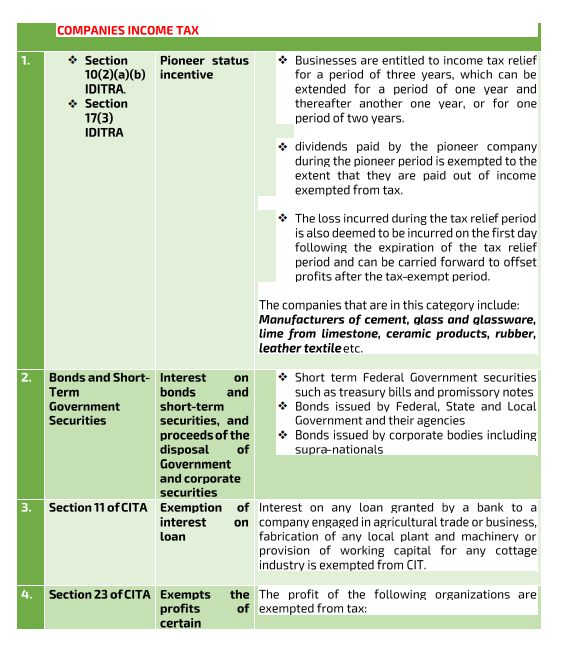
Companies Income Tax (CIT) is tax on the profits of incorporated entities in Nigeria. It also includes the tax on profits of non-resident companies who accrue or derive profits from Nigeria or bring or receive their income in Nigeria. It is therefore commonly referred to as corporate tax. CIT was created by the Companies Income Tax Act (CITA or the Act), it is one of the taxes administered and collected by the Federal Inland Revenue Service (“FIRS” or “the Service”).

Here are the tax incentives on CIT in Nigeria including the relevant incentives in the 2019 Finance Act:

What you need to know about Personal Income Tax Incentives in Nigeria

Tax incentives are special arrangements in the tax laws to attract, retain, or increase investments in a sector. Incentives may be granted on an industry basis.

To buttress on the definition; Tax incentives are deductions, exclusions or exemptions from a tax liability offered as an enticement to engage in a specified activity that would benefit the economy of a country in the long run.

In this piece, we have highlighted the relevant tax incentives related to the Personal Income Tax (PIT) in Nigeria including the relevant incentives in the 2019 Finance Act.

COVID-19, THE SAUDI-RUSSIA OIL WAR AND THE NIGERIAN OIL ECONOMY

Introduction

Over  90%  of  Nigeria’s  foreign  exchange  earnings  is  derived  from  the  Oil  and  Gas  Sector, constituting the very essence of the nation’s economy – a development following the 1956 breakthrough  discovery  of  oil  (in  commercial  quantity)  in  Oloibiri,  the present  day Bayelsa state. The Appropriation Acts of the Nigerian government, from past to present evidence a monotonous economy; one dependent on oil exports.

Read More

THE TAXAIDER NEWSLETTER VOL 2, ISSUE 4 (APRIL 2020)

First Thoughts: Much Ado About Changes!

In my last editorial exactly five weeks ago today, I mentioned that I was writing from somewhere besides my office desk for the first time in a while. Well, that has not changed much, except that I am not exactly writing from my reading table at home this time but of course, I am still at home like many of you probably are. It’s been six weeks and counting now since I started ‘remote working’ along with my work colleagues and millions of people all over the world.

Read More

Nigeria’s Common Reporting Standards – 6 Crucial Things Your Financial Institution Should know (Part 2)

  1. What Information is required under the CRS

Reporting Financial Institution (RFI) – Simply put, these are institutions located in participating jurisdictions that is not a Non-Reporting Financial Institution. As mentioned earlier they are depository institutions, custodial institutions, investment entities and specified insurance companies

Non-Reporting Financial Institution means a financial institution that is excluded from reporting and includes government entity, participation retirement fund, other low risk entity, an exempt collective investment vehicle and a Trust to the extent that the trustee is a RFI and reports all information required with respect to Reportable accounts of the Trust. A RFI is required to gather and share with the Federal Inland Revenue Service (FIRS) information about financial accounts held by individuals and corporate entities that are tax resident in a Common Reporting Standard (CRS) participating jurisdiction. The FIRS would in turn share this information with the participating jurisdiction in which the account holder is tax resident, the details include;

Read More