


The 2019 Poverty and Inequality Report released by the National Bureau of Statistics (NBS) reveals that 40.1% of Nigerians are poor. In other words, on average 4 out of 10 individuals in Nigeria are estimated to have real per capita expenditures below 137,430 Naira per year.
According to the United Nations Population Fund (UNFPA) 2019 Population Statistics, Nigeria has a population of 201 million. This translates to over 80 million Nigerians who are considered
poor by national standards.

Companies Income Tax (CIT) is tax on the profits of incorporated entities in Nigeria. It also includes the tax on profits of non-resident companies who accrue or derive profits from Nigeria or bring or receive their income in Nigeria. It is therefore commonly referred to as corporate tax. CIT was created by the Companies Income Tax Act (CITA or the Act), it is one of the taxes administered and collected by the Federal Inland Revenue Service (“FIRS” or “the Service”).
Here are the tax incentives on CIT in Nigeria including the relevant incentives in the 2019 Finance Act:
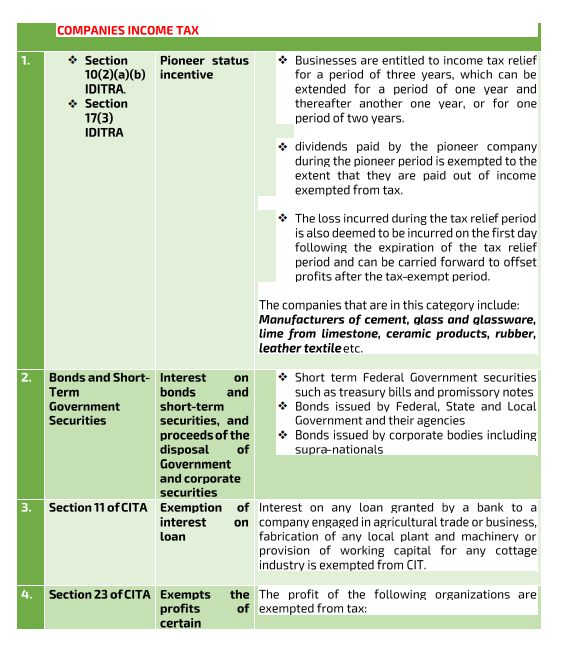


Tax incentives are special arrangements in the tax laws to attract, retain, or increase investments in a sector. Incentives may be granted on an industry basis.
To buttress on the definition; Tax incentives are deductions, exclusions or exemptions from a tax liability offered as an enticement to engage in a specified activity that would benefit the economy of a country in the long run.
In this piece, we have highlighted the relevant tax incentives related to the Personal Income Tax (PIT) in Nigeria including the relevant incentives in the 2019 Finance Act.


The novel Coronavirus (COVID-19) has been spreading like wildfire and the effects on the global economy are at best imagined. The latest Situation Report from the World Health Organisation (WHO) as at 06 May 2020 states that the total number of countries, areas and territories that have been affected by COVID-19 is 215[1].
Read More


Introduction
Over 90% of Nigeria’s foreign exchange earnings is derived from the Oil and Gas Sector, constituting the very essence of the nation’s economy – a development following the 1956 breakthrough discovery of oil (in commercial quantity) in Oloibiri, the present day Bayelsa state. The Appropriation Acts of the Nigerian government, from past to present evidence a monotonous economy; one dependent on oil exports.
Read More