The Central Bank of Nigeria (CBN) expects to achieve 2.38 per cent Gross Domestic Product (GDP) growth rate in the fourth quarter of this year.
Dr Hassan Mahmoud, the Deputy Director, Financial Policy and Regulation Department in CBN, said this in Yola at the 2019 workshop for financial journalists sponsored by the Nigeria Deposit Insurance Corporation (NDIC).
Mahmoud said that the GDP growth target would be an improvement over the third quarter growth rate of 2.28 per cent.
“If you are looking at the 1.1 per cent that we did in 2015/2016, and 2.28 per cent that we did in the third quarter of 2019, we will see that we have really moved substantially”.
President Muhammadu Buhari has named Mr. Muhammad M. Nami as the new chairman of the Federal Inland Revenue Service (FIRS).
He replaces Mr. Babatunde Fowler, whose tenure expired on Monday.He is a tax consultant and graduate of the Ahmadu Bello University, Zaria, Kaduna State.
“Mr. Muhammad, a well-trained tax, accounting and management professional with highly rated qualifications and professional practice and licenses from relevant professional bodies, has almost three decades of practical work experience in Auditing, Tax Management and Advisory and Management services to clients in the banking, manufacturing, services and public sectors as well as non-profit organisations,” the Presidency said in statement by spokesperson, Garba Shehu.
Buhari also approved the composition of the board of FIRS.
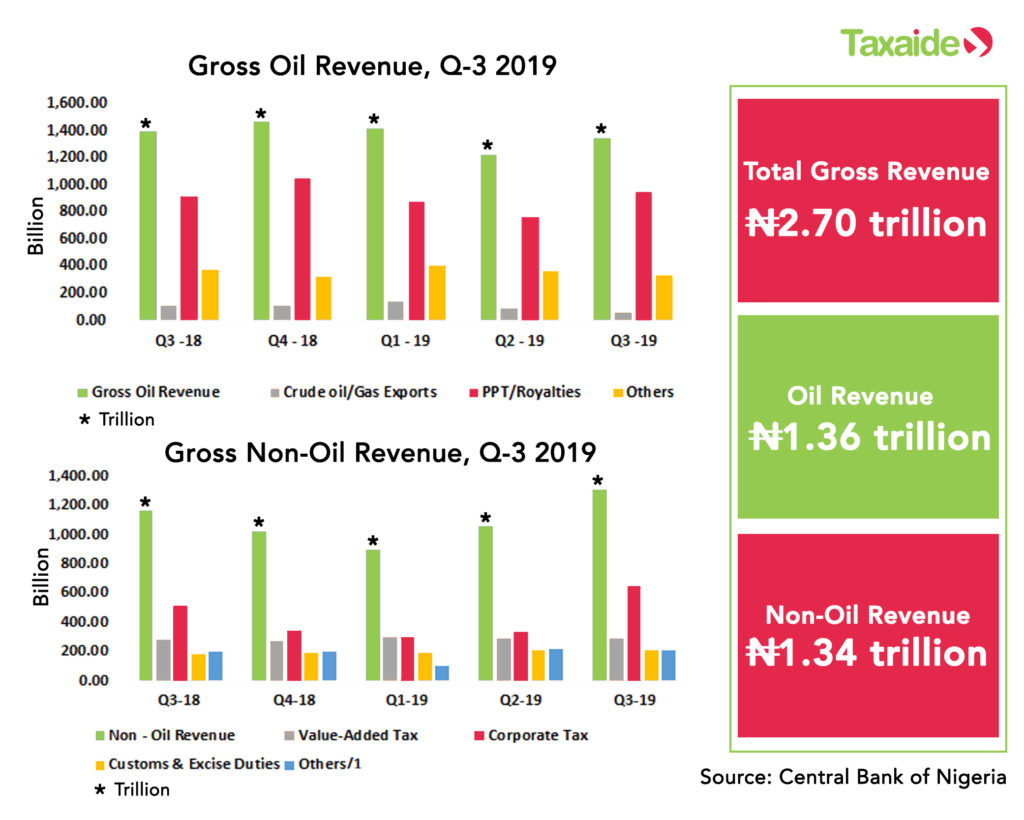
Sectoral distribution of Value Added Tax (VAT) data for Q3 2019 reflected that the sum of N275.12bn was generated as VAT in Q3 2019 as against N311.94bn generated in Q2 2019 and N273.50bn generated in Q3 2018 representing -11.81% decrease Quarter-on-Quarter and 0.59% increase Year-on-Year.
Did You Know that tax incentives are deductions, exclusions or exemptions from a tax liability offered as an enticement to engage in a specified activity that would benefit the economy of a country in the long run?
Did You Know that tax incentives are government measures intended to encourage individuals and businesses to either invest money into the economy or save money by reducing the amount of tax they are liable to pay
Did You Know also knowthat, in Nigeria, there are some incentives on Personal Income Taxes (PIT)?
The following are the four fundamental facts you need to know about the incentives given for PIT in Nigeria:
The National Bureau of Statistics recently released Q3 2019 reports and I had cause to actually wonder if perhaps we were finally getting something right. The recent border closure and its attendant effects have been met with a lot of reactions from people across all divides in Nigeria. It was a sudden paradigm shift. For once, it was looking like the leadership had finally found the nerve to make certain daring changes and because this wasn’t something we were quite used to, the resulting apprehension was quite understandable in all fairness.
Taxation, according to the Business Dictionary is defined as “a means by which governments finance their expenditure by imposing charges on citizens and corporate entities”. The term “taxation” is said to however apply to all involuntary levies, from income to capital gains to estate taxes irrespective of whether they are legal or not.
On July 1, 2019, Nigeria’s Federal Inland Revenue Service (FIRS) made the Income Tax (Common Reporting Standard) Regulations 2019 (the Regulations) to regulate how financial institutions are to report on the accounts maintained by persons that are not tax-resident in Nigeria or the United States of America. In this brief, we itemize 12 things your financial institution should know and do under the Regulations
On the
dashboard, Click payment. Select Taxes; then select P-A-Y-E
Fill in
the company’s details in the Employee Section and the description section
Click
Browse; select your schedule which should include details such as the name of
the employees, their citizenship, gross monthly salary, monthly tax deductible,
monthly tax remitted
Click
upload. Your payment goes straight to the Lagos State Internal Revenue Service
(LIRS)
How easy was that? And you know the best part; it is absolutely free!
I can’t wait to have your feedback on the process and how you made your tax remittances easily.
N.B: To remit taxes (PAYE) through TaxiTPay, your wallet needs to be funded. This is can be done easily with your debit or credit card.
They’re bonuses are awesome, their VIP loyalty program is far superior than any other online casino out there. Diamond 7 does not accept players from the following countries: Afghanistan, Asia, Algeria, Africa, American Samoa, Oceania, Angola, Australia, Austria, Belgium, Bolivia, Bulgaria, Cuba, Denmark, Ecuador, Ethiopia, France, French Guiana, French Polynesia, French Southern Territories, Germany, Ghana, Guam, Guyana, Indonesia, Iran, Iraq, Israel, Italy, Kenya, Lao People's Democratic Republic, Latvia, Myanmar, Nigeria, Norfolk Island, Northern Mariana Islands, Pakistan, Panama, Papua New Guinea, Poland, Romania, Russian Federation, Sao Tome and Principe, Singapore, Singapore, South Africa, Spain, Sri Lanka, Sri Lanka, Sudan, Syrian Arab Republic, Tanzania, United Republic of, Tanzania, United Republic of, Thailand, Turkey, Turkey, Uganda, Uganda, United States, United States, United States Minor Outlying Islands, Viet Nam, Viet Nam, Virgin Islands, U. Don’t forget to use your 205% deposit match bonus code too https://nejlepsionlinekasina.net/. Feb 20 came and went with no fanfare and, more importantly, no new casino.
Integrated with TaxiTPay® to enable seamless disbursement of VAT to the RTA or other VAT collection agent.
Cloud-based Technology: Work from anywhere and anytime.
Notifications & Reminders: Built-in real-time notifications and alert system to help you stay compliant and keep up with your obligations.
Mobile Compatibility: Work from your mobile device.
Instant Data Import: The built-in data import tools make data migration into TaxiTVAT® painless thereby giving you a smooth onboarding experience.
Fraud Control: Checks against fraud and illicit financial transactions with the user-role console to set-up administrators, approvers, and disbursers functions.
Data Security: Highly private, confidential, secure and encrypted data including soft token generation.
User Intelligence Experience: Analytical and interactive dashboard interface displaying a general awareness and overview of when and how vendor payments and tax obligations are met.
With no upfront software costs, you wouldn’t need to break the bank to afford TaxiTVAT®
There’s no software installation hassle and TaxiTVAT® updates automatically.
You can automatically export your TaxiTVAT® information into spreadsheets as the relevant general ledger.
TaxiTVAT® is scalable; it expands as your business grows, allowing you to undertake complex VAT computation, including Input and Output Tax computations.
Taxit Withhold
Direct Disbursement: Sorts out payment to vendors and RTAs and disburses payments directly to their individual bank accounts instantly.
Integrated with TaxiTPay® to enable seamless disbursement of payments to vendors and RTAs.
Automatic Payment Processing: Retains and sorts out all obligations to vendors, computes withholding tax (WHT) and ensures scheduled payments to vendors and RTAs.
Cloud-based Technology: Work from anywhere and anytime.
Notifications & Reminders: Built-in real-time notifications and alert system to help you stay compliant and keep up with your obligations.
Mobile Compatibility: Work from your mobile device.
Instant Data Import: The built-in data import tools make data migration into TaxiTWithhold® painless thereby giving you a smooth onboarding experience.
Fraud Control: Checks against fraud and illicit financial transactions with the user-role console to set-up administrators, approvers, and disbursers functions.
Data Security: Highly private, confidential, secure and encrypted data including soft token generation.
User Intelligence Experience: Analytical and interactive dashboard interface displaying a general awareness and overview of when and how vendor payments and tax obligations are met.
With no upfront software costs, you wouldn’t need to break the bank to afford TaxiTWithhold®
There’s no software installation hassle and TaxiTWithhold® updates automatically.
You can automatically export your TaxiTWithhold® information into spreadsheets as the relevant general ledger.
Information available in formats sufficient for filing monthly WHT Schedules
TaxiTWithhold® is scalable; it expands as your business grows, allowing you to add as many vendors or pay cycles as you like.
Tbook
TBook® allows taxpayers to manage their tax affairs and have access to online real time information about their taxes and other statutory obligations.
Notifications: Built-in real-time notifications and alert system to help you always stay informed of payments made to or on your behalf including receiving your TaxiTPaySlip®.
Ideal for all employees of organizations that use TaxiTPayroll® or persons who receive payments via TaxiTPay®.
Data Security: Highly private, confidential, secure and encrypted data including password access
User Intelligence Experience: Analytical and interactive functions to enable you to generate choice information.
At no cost, TBook® is freely available as long as your smartphone has sufficient data. TBook®’s data usage is very minimal.
There’s no software installation hassle and TBook® updates automatically.
You can automatically export your TBook® information into spreadsheets as your personal ledger.
Information is available in formats sufficient for filing your personal income tax returns.
Taxit Pay
One Stop hub for all payments, tax computations and deductions E-banking is the now the norm. To keep tabs on all tax deductions, organisations need a platform that can help track all transactions and keep track of all tax liabilities reducing the stress of computing a huge block of transaction annually.
Time Sensitive: Tax and related payments made in timely and stress-free fashion
Multi-application: Optimized for making diverse forms of payments and remittances which include net salaries, vendor payments, pensions, and major tax obligations.
Receipting: Integrated instant receipt-generating function that gets you your tax and related receipts straight from the RTAs
Generate employee pay slips (TaxiTPaySlips®) from TaxiTPay®
Integrated with TaxiTPayroll®, TaxiTWithhold®, TaxiTVAT® to allow their users smooth and seamless disbursement of relevant payments.
Cloud-based Technology: Work from anywhere and anytime.
Mobile Compatibility: Work from your mobile device.
Fraud Control: Checks against payment frauds and illicit financial transactions with the user-role console to set-up administrators, approvers, and disbursers functions.
Data Security: Highly private, confidential, secure and encrypted data including soft token generation.
User Intelligence Experience: Analytical and interactive dashboard interface displaying a general awareness and overview of when and how payments are made.
With no upfront software costs, you wouldn’t need to break the bank to afford TaxiTPay®
There’s no software installation hassle and TaxiTPay® updates automatically.
TaxiTPay® is scalable; it expands as your business grows, allowing you to undertake as many payments as you like.
Taxit Payroll
[vc_row][vc_column][vc_column_text]
TaxiTPayroll® provides the most robust solution for payroll taxes and tax obligations in Nigeria. TaxiTPayroll® offers an easy to use online application that supports entrepreneurs and small businesses. Accessible 24/7 online, it allows you to grow your business and offers a simple way to get things done.
With no upfront software costs, TaxiTPayroll® won’t break the bank.
There are no software installation hassle and your payroll software updates automatically.
With our smart online payroll solution, your payroll expands and shrinks as your business grows, allowing you to add as many employees or pay cycles as you like.
You can automatically update your payroll general ledger.
Direct Disbursement: Sorts out the remuneration of employees and disburses payments directly to their individual bank accounts instantly.
Automatic Tax Processing: Retains and sorts out all statutory payroll obligations, computes payroll taxes and remits all at once and instant payment to the relevant agencies and agents (RTAs, PFAs, NHF, NSITF, ITF etc.) as payments fall due.
Cloud based Technology: Work from anywhere and anytime.
Notifications & Reminders: Built in real-time notifications and alert system to help you stay compliant and keep up with your payroll obligations.
Mobile Compatibility: Work from your mobile device.
Instant Data Import: The built-in data import tools make data migration into TaxiTPayroll® Painless thereby giving you a smooth onboarding experience.